



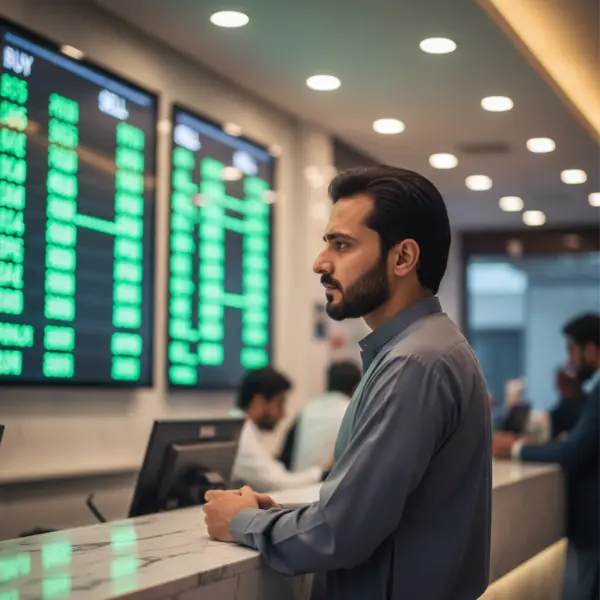
Have you ever exchanged money and felt like you somehow lost more than you expected — even though the rate on the board didn’t look too bad?
That feeling usually comes from not understanding buying and selling rates. These two numbers quietly decide how much you actually pay when you exchange currency, and for most people, they matter far more than the headline exchange rate they see online.
If you’re new to exchange boards, it helps to first understand how rates are displayed — you can start with our guide on How to Read Currency Exchange Rates.
This guide explains how buying and selling rates work, why the difference exists, and how that gap directly affects the real cost of currency exchange — using clear, everyday examples in Pakistani Rupees (PKR).
What Are Buying and Selling Rates in Currency Exchange?
Every currency exchange quote has two prices, not one:
- Buying rate: the price an exchange will pay you when they buy foreign currency from you
- Selling rate: the price you pay when you buy foreign currency from the exchange
The difference between these two numbers is what shapes your actual cost.
In simple terms:
- You always buy at the higher rate
- You always sell at the lower rate
That gap is not accidental — it’s built into how currency exchange works.
A Simple PKR Example (Easy to Visualize)
Let’s say you walk into an exchange and see the following USD rates:
- Selling rate: ₨280
- Buying rate: ₨275
If you buy 1 USD, you pay ₨280
If you sell 1 USD, you receive ₨275
That ₨5 difference doesn’t go missing — it’s the built-in cost of the exchange.
This difference becomes more noticeable as amounts increase. On larger transactions, even a few rupees per dollar can add up quickly.
Why Is the Buying Rate Always Lower Than the Selling Rate?
Many people assume the two rates should be almost the same. In reality, the gap exists for practical reasons.
1. Business operating costs
Currency exchanges have real expenses: rent, staff, security, systems, and compliance requirements. These costs must be covered.
2. Market movement risk
Rates can change while an exchange is holding cash. The gap helps protect them from sudden price movements.
3. Supply and demand for cash
If many people want USD cash at the same time, the selling side becomes more expensive. If many people are selling USD, the buying side adjusts too.
4. Cash handling and verification
Physical cash requires checking, counting, and record-keeping — especially for foreign notes.
5. Profit margin
Like any business, exchanges earn through pricing. The buying-selling gap is a primary source of income.
The key point is simple: the gap is normal. What matters is whether it’s reasonable for the situation.
The Real Cost Most People Miss
Most people focus on the headline rate — the number they see online or hear on the news. But that number is usually not the rate they actually receive.
The real cost of exchanging money is hidden inside:
This difference is commonly known as the exchange rate spread, which plays a major role in how much you actually lose or gain.
- the gap between buying and selling rates
- any extra service fees
- the direction of the transaction (buying vs selling)
Two places may advertise similar rates, but the one with the tighter gap usually costs you less.

Bank Rates vs Exchange Company Rates — Who Is Better?
There’s no universal winner. It depends on how and why you’re exchanging money.
Banks can be better when:
- the transaction is linked to accounts or transfers
- documentation and formal channels are required
- convenience matters more than speed
Exchange companies can be better when:
- you need physical cash
- you want to compare multiple quotes quickly
- timing and flexibility matter
The actual difference often comes down to:
- cash vs transfer
- transaction size
- location and local demand
When Does the Buying–Selling Gap Get Wider?
You’ll usually notice a bigger difference in these situations:
- Weekends or after-hours, when markets are less active
- High-uncertainty periods, when prices move faster
- Low-liquidity currencies, not commonly traded
- Very small transactions, where margins are wider
- High-convenience locations, like airports
A wider gap doesn’t always mean unfair pricing — but it’s worth comparing.
How to Calculate the Buying and Selling Rate Difference
You don’t need financial knowledge to do this.
Method 1: Simple PKR difference
Selling rate − Buying rate
Example:
₨280 − ₨275 = ₨5 spread
Method 2: Percentage difference (optional)
(Spread ÷ Selling rate) × 100
Example:
(5 ÷ 280) × 100 ≈ 1.8%
This method helps when comparing different currencies or locations.
How to Reduce Your Currency Exchange Cost
You don’t need to chase tiny differences daily — just avoid common mistakes.
- Compare at least two places
- Avoid high-convenience counters if possible
- Exchange once instead of multiple small transactions
- Ask clearly: “Is this the final rate I will pay/receive?”
- Keep your receipt and confirm the numbers
Understanding the rates gives you control — not stress.
Is the difference a fee or profit?
It can be both. The gap covers costs, risk, and profit. Some places also charge separate fees.
Is this the same as commission?
No. Commission is an extra charge. The buying-selling gap is built into the rate itself.
Why do two exchanges quote different rates in the same city?
Because their costs, cash availability, and local demand can differ.
Do buying and selling rates change during the day?
Yes. Rates can tighten or widen as demand and market conditions change.
Final Takeaway
Buying and selling rates quietly decide how much you really pay when exchanging money. Once you understand how they work, the confusion disappears.
You stop guessing.
You start comparing calmly.
And you avoid paying more than necessary — without needing to be a finance expert.
That’s the real power of understanding currency exchange.