



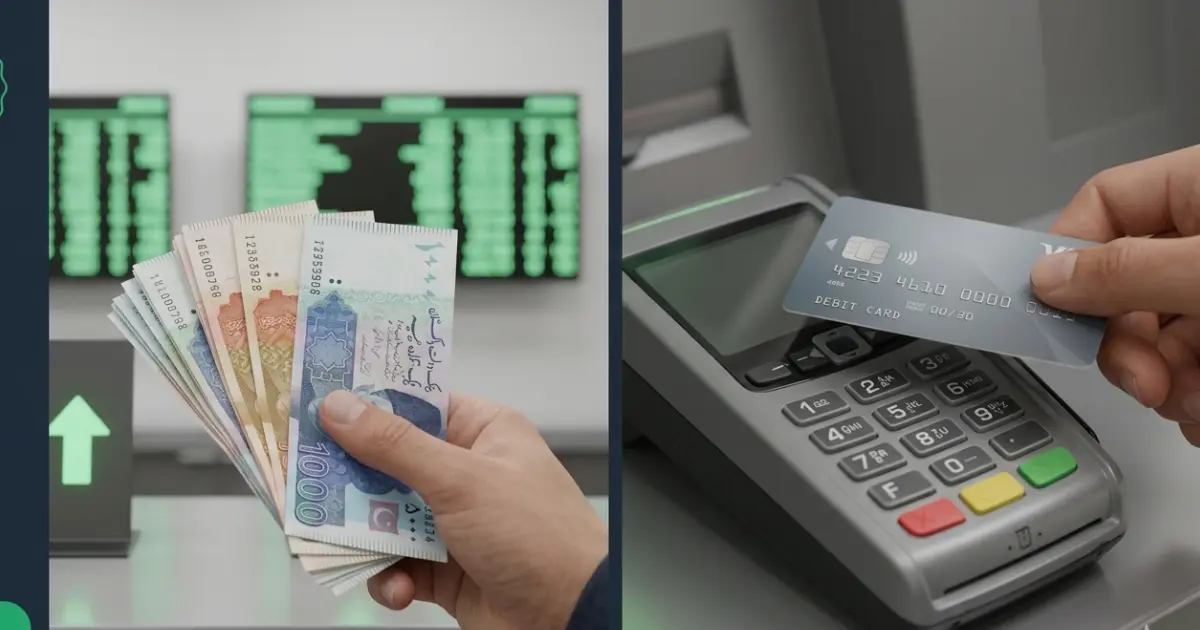
In Pakistan, card exchange rates are often higher than cash rates because card payments use Visa/Mastercard network conversion plus your bank’s fees/markup, while cash exchange uses buying vs selling board rates and spreads. Google usually shows a reference rate, not your final charged amount.
Card rate vs cash rate in Pakistan (what’s the difference?)
Cash rate is what you get at a money exchange counter (or what your bank gives for cash). It usually has a buying rate and a selling rate, plus a spread (their margin).
Card rate is what happens when you pay by card or withdraw from an ATM. It usually involves a network conversion rate (Visa/Mastercard) plus issuer (bank) fees or markup. So even on the same day, cash and card can show different results.
Why card exchange rate is higher in Pakistan
- Foreign transaction fee: many banks charge a fee for international/foreign-currency transactions (or build it into pricing).
- Bank foreign currency markup: on top of the network rate, the issuing bank may add a markup (sometimes shown separately, sometimes baked in).
- Network timing window: Visa/Mastercard use daily FX rates and settlement timing, so your transaction may post later than when you checked the rate.
- Dynamic Currency Conversion (DCC): when a terminal/ATM offers “Pay in PKR?”, it can include extra fees/markup. In many cases, paying in the original currency avoids DCC pricing.
- ATM fees + conversion fees: ATM withdrawals can add operator fees and bank fees, and conversion rules can differ from a simple card purchase.
Visa exchange rate Pakistan (how it’s usually applied)
Visa provides daily FX rates used within Visa’s network. But the final amount you pay can change if your bank applies a different rate than a public calculator, and/or adds foreign transaction fees. So “visa exchange rate pakistan” is best understood as:
Visa rate (reference) + bank fee/markup = your final charged amount.
Mastercard exchange rate Pakistan (how it’s usually applied)
Mastercard also uses network FX rates for cross-border purchases and ATM transactions. Your final amount can differ if the merchant/ATM does the conversion (often when DCC is accepted), or if your bank adds its own fees/markup. So “mastercard exchange rate pakistan” is usually:
Mastercard reference rate + issuer (bank) fees/markup.
ATM conversion rate Pakistan (why ATM feels expensive)
ATMs are where people often feel the biggest difference. Common reasons include:
- ATM operator fee (sometimes shown on screen)
- Your bank’s foreign withdrawal fee
- Conversion fees/markup
- DCC at ATM (ATM offers to charge you in PKR/home currency)
If you see a choice like “Charge in PKR?”, the safer move in most cases is to pay in the original currency and let your bank/network do the conversion (to avoid DCC markups).
Why bank exchange rate is different from Google
This is one of the biggest confusion points:
- Google shows a reference/mid-market style rate (useful for learning, not guaranteed for settlement).
- Banks and card networks apply their own rates and timing, and banks may add fees/markup.
- Cash exchange counters show buy/sell rates, which include spread.
So “why bank exchange rate is different from google” usually comes down to fees + spread + timing + pricing source.
Quick checks to avoid paying extra
- Avoid DCC: if a terminal/ATM offers “Pay in PKR?”, decline and pay in the original currency (when possible).
- Know your bank’s fee: check your bank’s schedule of charges for foreign card usage/international transactions.
- Use cash for big planned amounts: for large conversions, compare a good exchange counter vs card cost.
- Minimize ATM withdrawals: fewer withdrawals often means fewer fixed fees.
Mini example (2026-style, realistic, not a live rate)
Example (not a live rate): You check a reference rate and estimate your purchase should be 100,000 PKR. But your card statement shows 103,000 PKR.
A common reason is a combined effect of bank markup/fee, network timing differences, and sometimes DCC/merchant conversion if “pay in PKR” was accepted. That extra 2–4% is exactly what people mean when they say the card conversion rate feels higher.
FAQs
Card rate vs cash rate in Pakistan — which is better?
For small convenience purchases, card is easy. For large conversions, cash exchange can be cheaper if you compare spreads/fees and avoid bad counters.
Why card exchange rate is higher in Pakistan?
Usually because of bank fees/markup, network conversion timing, and sometimes DCC at the merchant/ATM.
Visa exchange rate Pakistan — is it the final rate?
Not always. Your bank may apply a different rate and/or add foreign transaction fees, so the final posted amount can differ.
Mastercard exchange rate Pakistan — why different from Visa?
They can differ due to different network reference rates/timing windows, and your bank’s pricing can also change the final amount.
ATM conversion rate Pakistan — why so high?
ATM withdrawals can include operator fees, bank withdrawal fees, and sometimes DCC conversion choices.
Foreign transaction fee Pakistan — what is it?
It’s a fee banks may charge on foreign/FX card transactions (sometimes shown separately or built into pricing).
Bank foreign currency markup Pakistan — how to check?
Check your bank’s schedule of charges or card pricing page. Look for “foreign transaction fee”, “FX markup”, or “international transaction charges”.
Why bank exchange rate is different from Google?
Google shows a reference rate. Your bank/card network may use different timing/rates and add fees/markup; cash exchange uses buy/sell spreads.
Quick takeaway
If your card rate looks worse than cash in Pakistan, it’s usually fees + markup + timing (and sometimes DCC). Avoid DCC, know your bank’s charges, and compare based on the amount.