



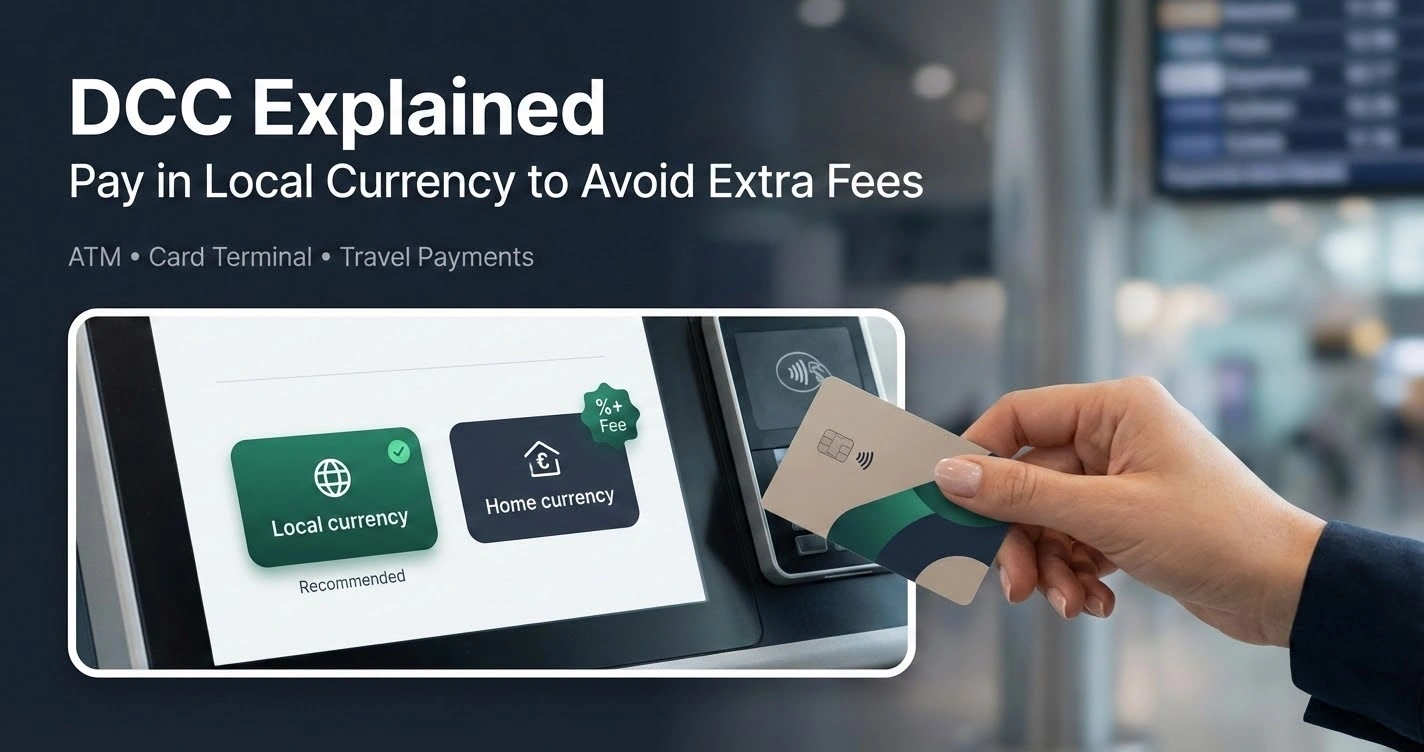
Dynamic currency conversion (DCC) is when an ATM or card terminal offers to charge you in your home currency instead of the local currency—often using a worse exchange rate and extra markup. In most cases, choosing local currency is the cheaper option.
If you’ve ever seen “Pay in your home currency?” or “Guaranteed rate” while traveling, this guide explains what’s happening and what to choose in 5 seconds.
DCC meaning (in plain English)
DCC meaning: the conversion happens at the point of sale (POS) or ATM, not later by your bank.
You’ll see DCC offers:
- on card terminals in shops, hotels, restaurants
- on ATMs when withdrawing cash
- sometimes on online checkout pages
The key choice is always the same:
Pay in local currency (usually better) vs pay in home currency (often costs more).
Why a DCC fee happens (the real cost)
DCC is typically provided by a merchant/ATM owner and their DCC provider, and the customer is usually charged more than a normal card conversion.
That “extra” can show up as:
- a clearly stated DCC markup/fee, or
- a worse exchange rate embedded in the offer (the most common), or both.
Dynamic currency conversion at POS (card terminal)
This is the typical scenario:
- You tap/insert your card abroad
- The terminal detects your card’s home country/currency
- It offers you a choice: local currency or home currency (DCC)
Pay in local currency or home currency?
- Choose local currency in most cases.
- Choose home currency (DCC) only if you’re okay paying extra for the convenience of seeing the final amount immediately.
A simple line you can use at the counter:
“Please charge me in local currency.”
Dynamic currency conversion at ATM (often the most expensive)
ATMs are where DCC can sting the most, because you might pay:
- ATM operator fees
- plus DCC markup/worse rate
- plus your bank’s foreign withdrawal fees (depending on the card/bank).
The ATM wording varies by country, but the safe choices usually look like:
- Continue without conversion
- Charge in local currency
- Decline conversion
If the ATM forces conversion with no way to decline, consider cancelling and using another ATM.
Should I accept dynamic currency conversion?
In most situations: No. Choose local currency.
When could DCC be acceptable?
- If you value certainty over savings and you clearly understand the rate/markup being offered.
- If your company reimburses a fixed home-currency amount and you want a predictable receipt.
Two red flags:
- Guaranteed rate (often means expensive)
- 0% commission (the cost may be hidden in the rate)
How to avoid dynamic currency conversion (quick checklist)
- Always select local currency on the screen.
- If asked verbally, say: Local currency, please.
- On ATMs, choose without conversion / decline conversion.
- Avoid terminals/ATMs that pressure you or hide details (that’s a trust signal).
- Know your card’s foreign fees/markup (that’s separate from DCC).
Is dynamic currency conversion a scam?
People often call “dynamic currency conversion scam” because it can be misleading and expensive. But DCC itself is generally a real service—the issue is transparency and pricing.
A more accurate way to think about it:
- DCC is an optional convenience that often comes with a markup.
- The safest consumer choice is usually to decline and pay in local currency.
Mini example
Example:
You’re traveling and your purchase is €100. The terminal offers:
- Pay €100 (local currency), or
- Pay your home currency via DCC at a “guaranteed” rate.
If the DCC offer includes even a small markup (say 3–5%), you’ll pay noticeably more than letting your bank/network convert normally.
That’s why frequent travelers default to: local currency.
What is dynamic currency conversion?
Dynamic currency conversion is when an ATM or card terminal converts the amount into your home currency at the point of sale/withdrawal, often including extra fees/markup.
DCC meaning — what does it mean on my receipt?
It usually means you accepted the “pay in home currency” offer and the conversion happened at the merchant/ATM side instead of your bank later.
Should I accept dynamic currency conversion?
Usually no—choose local currency. Accept DCC only if you knowingly prefer convenience over cost.
How to avoid dynamic currency conversion at ATM?
Choose “continue without conversion” or “charge in local currency.” If the ATM forces conversion, cancel and try another ATM.
Dynamic currency conversion at POS — local currency or home currency?
Pick local currency in most cases. Home currency is usually the DCC option and often costs more.
What is a DCC fee?
A DCC fee/markup is the extra cost built into the DCC offer—sometimes shown as a fee, but often embedded in a worse exchange rate.
Why is my bank exchange rate different from Google?
Google often shows a reference rate. Your final amount can differ due to bank fees/markup, network timing, and if DCC was used.